• Home
  • About Tracy
  • Contact Me

Using Time Wisely

Organized to save money, energy, and time

  • Email
  • Facebook
  • Pinterest
  • RSS
  • Twitter
  • YouTube
  • Document Organization
    • Overview
    • Box 1
      • Credit Report/Cards
        • Credit Reports
          • Credit Updates
          • Credit Scores
        • Credit Cards
      • Personal
      • Home Ownership
      • Vehicles
    • Box 2
      • Life Insurance
      • Major Medical
      • Tax-Favored Programs
      • Prescriptions
      • Dental & Vision
      • Special Health Policies
      • Short-term Disability
      • Long-term Disability
      • Personal Insurance
    • Box 3
      • Social Security Documents
      • Retirement
      • Investments
      • Estate Planning
      • Tax Records
  • Household
    • Cleaning
    • Maintaining
    • Organizing
    • Scheduling
      • Laundry
  • Event Planning
    • Assisting
    • Attending
    • Coordinating
      • Birthday Party
      • Christmas
      • Dinner Party
      • Fall Festival
      • Field Trip
      • Lemonade Stand
      • Thanksgiving
    • Learning
    • Preparing
    • Serving
  • Miscellaneous
    • Communication
      • Customer Service
      • E-mail
      • RSS Feed Reader
    • Goals
    • Organization
    • Time Management
      • To Do List
  • Food
    • Food Prep
    • Grocery Shopping
      • Lists
      • Pricing
    • Menu Planning
    • Recipes
    • Stockpile
  • Family Activities
    • Going Out
      • Free Outings
      • Inexpensive Outings
      • Summer
    • Rewards
      • Good Grades
      • Reading
      • Summer Reading
    • Staying at Home
  • Stretching Your Dollars
    • Daily Deals
      • Groupon
      • LivingSocial
    • Drugstores
      • CVS
    • Gas Prices
    • Gifts
    • On-line Shopping
    • Pictures
    • Products
    • Restaurants
    • School Items
    • Tips
You are here: Home / 2012 / Archives for January 2012

Archives for January 2012

Evaluating: Taking a Step Back – Part 1 of 3

January 26, 2012 by Tracy

Photograph Credit: Flickr (Cyberhawk Innovations)

When the hustle and bustle of grocery shopping has ceased and in the calm of my household (in theory), I evaluate by taking a step back to review, learn, and strategize.

Just taking 5 minutes to note the great deals, the bypassed deals, and the did-I-really-need-that deals, I learn more about how I shop and how to improve on my next shopping adventure.

To help improve my grocery shopping savings, I review the grocery list, where I jotted down ideas and made notes.

Reviewing your Grocery List

After putting away all the groceries and cleaning up the kitchen, I take a moment to check the grocery list. In looking over the list, ask these questions:

1. Did you jot down any menu planning ideas?

If so, add those ideas to your menu. With my menu planner on the refrigerator, I turn from my counter to the refrigerator and write the ideas on the schedule.

2. Did you get everything on your list?

If yes, are you pleased with this shopping trip? If not, why not? (Answers will vary.) How can you improve?

If not, why did you choose to bypass the deal?

If not, due to out-of-stock items, did you get a rain check? Was the rain check written correctly? Does the rain check expire? If so, place it near the front of your store envelope to use on your next trip.

3. Did you buy more items than you planned?

Did you need those items, or was it an impulse buy? If an impulse purchase, were you hungry? Influenced by your children?

Using these questions while reviewing your shopping list can pinpoint areas where you excel while revealing your tendencies. By taking a step back and reviewing my shopping trips, I learn what I did right, what I bombed, and how I can improve.

As you seek to see the deep savings each week, learning how to decide a good deal from a great deal will get you on your way. Just take it slowly and take a step back to learn from each shopping trip. In using time wisely, spending 5 minutes to check your progress is worth seeing those deep savings as you improve. Happy savings!

Question: How often do you buy only what is on your shopping list? Please add your answer to the comments.

Filed Under: Grocery Shopping, Food Tagged With: grocery shopping

Time Management: 7 Ways to Recharge your Energy

January 25, 2012 by Tracy

Photograph Credit: Flickr (Ligia Santos Rodrigues)

After dealing with car issues all last week on top of congested children, I found myself worn out and exhausted by the end of the weekend. In preparing for house guests and continuing to purge, clean, and organize our home, my energy has slowly been depleted.

Since my energy battery needed to recharge fully before taking on another project, I took a little break yesterday. When you need to replenish your energy, try one or more of these seven options:

1. Complete a maintenance task

I chose to complete two loads of laundry. In taking my time folding and putting away, I maintained the laundry pile without overworking or over-thinking. By finishing one task, you will not feel that your day was in vain. Choose an easy, but necessary, household task to keep you on track.

2. Play with your children

My girls overflow with energy, and I am either rejuvenated or exhausted while playing with them. To stay relaxed, I held items my toddler brought to me and watch my preschooler play an X-Box game. Both enjoyed the time with Mom while Mommy replenished.

3. Exercise

Take your kids for a walk. The weather was nasty yesterday, so we stayed indoors. But just getting up and moving around will improve your energy level.

4. Fix simple meals

In keeping to the basics yesterday, I fed my family without exhausting myself in the kitchen.

5. Take a warm bath

After each day, I enjoy soaking in a warm bath. A few moments of quiet and relaxation prepares me for a great night’s sleep.

6. Read a book

After putting my children to bed and checking e-mail, I turned off the computer, took a warm bath, and crawled into bed with a blogging book. In the quiet, I can read, think, and exercise my brain.

7. Get your rest

Oh, bedtime . . . what a nice time of day to rest and recharge for the next day. Choosing to retire an hour earlier than usual, I fell right to sleep. With my energy replenished, I awoke this morning ready to take on the day.

Mommies give and give and give. Remember you need to recharge your energy for yourself and your family. Taking a little break may restore your energy for the next round of activity. My little break was worth using time wisely to recharge. Now off to wake up my little sleepy heads. Happy relaxing!

Question: How do you recharge your energy? Please add your answer to the comments.
Filed Under: Time Management, Miscellaneous Tagged With: time management

Christmas Program: Directing a Children’s Play – Part 3 of 3

January 24, 2012 by Tracy

Any successful event begins with planning. The larger the event, the more planning needed to pull it off.

With a play, I spend two-thirds of my time planning all the details before the cast enters the rehearsal space. Knowing the framework helps me progress through rehearsals while using time wisely.

In part 1, planning the script, set, and properties forms the outward framework for the production. Then in part 2, developing the cast and crew, costumes and lighting conform to the framework for a cohesive whole.

After planning for so long, the time comes to execute those plans in rehearsals, through the program notes, and presented at the performance.

Rehearsals

With this performance, the action switched from the modern family to the traditional manager scene characters. Since all the practices occurred during school hours, I chose to work with either the modern family actors or the traditional manager scene characters up until performance week. During these rehearsals, we worked on the following:

Blocking. These are the entrances, exits, and movements on stage. By walking through the path they travel as they communicate their lines, the actors become more comfortable with their parts and confidence builds.

Line Interpretation. Assisting actors with attitude, understanding, and pronunciation of difficult words guides them to effectively communicate the script.

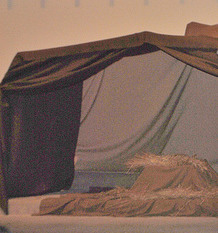
Characterization. Teaching the Wise Men to stand up straight while the Donkey should slump his shoulders due to his heavy burden is part of creating a character. Each actor is unique and brings a flavor to that character’s part. Encouraging play and experimenting results in some fabulous outcomes.

Motivation. Giving the actors the purpose behind their line prods them in the conflict, contrast, or amusement. Keeping the actors motivated in their communication brings intensity to an otherwise static performance.

Projection. In our performance space, we do not use microphones. To encourage the children to project their voices, I spend a full rehearsal concentrating on speaking to the ball field on the other side of the parking lot. Without screaming, the students work to increase their performance skills.

Tempo/Timing. Putting it all together with all the actors and the music usually produces many stops and starts. To get the performance to a smooth transitioning point, the tempo/timing rehearsal focuses on the transitions between the scenes. By reminding and guiding the actors, this rehearsal gets the production ready for full run practices.

Full Runs. To instill all the elements practiced, the final rehearsals are full runs including a dress rehearsal. Allowing the students to try-on their costumes helps to know where to adjust to accommodate angel wings and shepherd staffs. After these final adjustments, we are ready for performance evening.

Program

Though a program distributed to the attendees on the day of the performance can range from simple to complex, I chose to write director’s notes for the program. By including the scenes and words to the songs for the congregation, the list of cast and crew, and the director’s notes, the program for this production ended up taking 2 full 8.5”x11” sheets of paper. The finished program was a folded 4-page front and back booklet.

Since I enjoy writing the notes and including details for our parents, grandparents, and friends, my programs are lengthy. Some programs are as simple as listing the title and cast and crew. Depending on your time frame and the type of performance, your program length may change from simple to detailed.

Performance

By staying organized with each child’s costume labeled and set at his assigned place in the green room (for this performance the choir room), the children arrived, found their items, and enjoyed taking pictures while preparing for their performance. Knowing their entrances and exits, the cast performed well with seamless transitions.

All the children remembered their lines, their movements, and their properties. The planning resulted in a successful performance proclaiming the miraculous birth of Jesus Christ, the Savior of the world.

Whether you are directing a children’s program, a play for adults, or skits for a birthday party, spending the time planning before entering rehearsal will be using time wisely. Getting the framework in place keeps you focused to execute a successful event. Happy planning!

Question: What event is on your horizon? Please add your answer to the comments.
Filed Under: Christmas, Event Planning, Coordinating Tagged With: Christmas

Organizing: Creating Play Stations

January 23, 2012 by Tracy

With three children, who are two years apart and both genders, our house has a range of toys. Without an organizational system, we would live among the toys. 😉

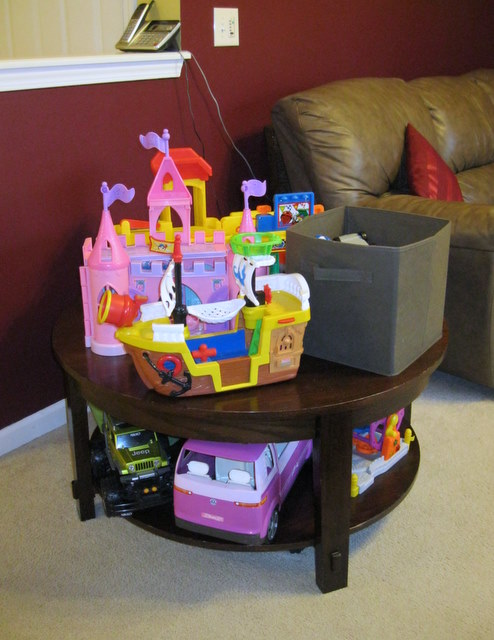
In working through each room of my house clearing out clutter, cleaning, and organizing, I decided to try creating a Little People play station for my girls.

Though my son has out-grown most of the Little People items, he does enjoy playing with the toddler. However, my girls will be playing more at this station than my son.

Determining the Functions of the Play Station

Since this space is mostly for my girls, I needed the play station to meet the following criteria:

1. Low enough for the toddler to reach.

2. Large enough to hold the 8-10 Little People play units.

3. Wide enough for both girls to play at the same time.

4. Room enough to move around the station without blocking traffic.

5. Small enough to fit in our living room with the rest of the toys.

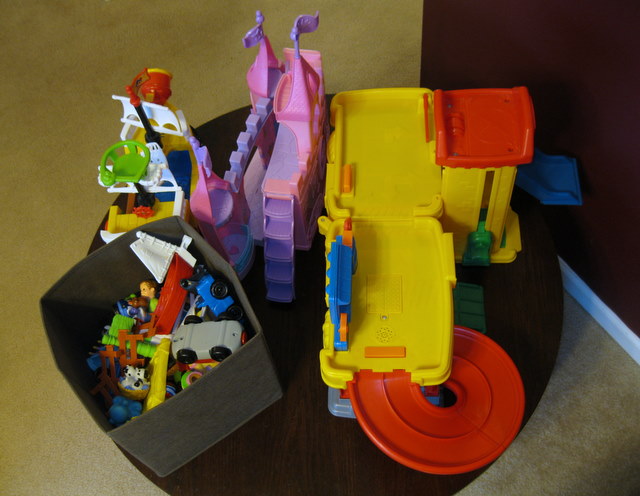
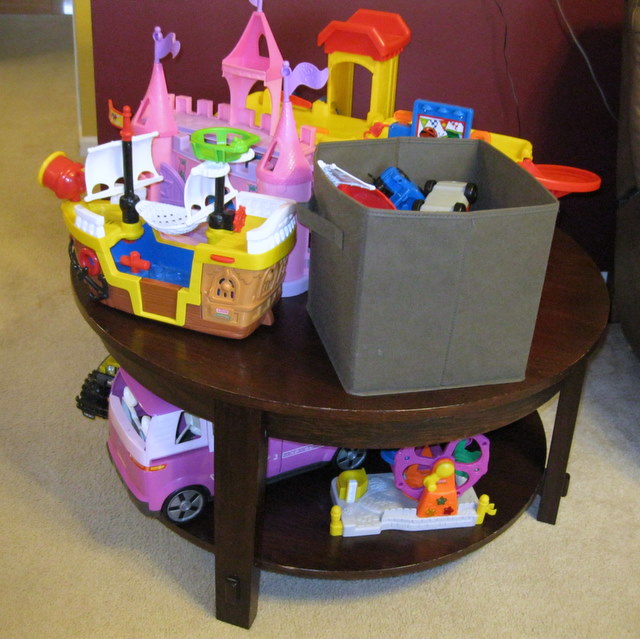
Keeping within my limited budget, I surveyed our current options and found that our circular coffee table (which has never been used as a coffee table since my children overtake most of the furniture in the house) fit all these standards. With a $6 fabric bin to hold all the accessories, this play station exceeded my expectations.

Evaluating the Workability of the Play Station

1. My toddler loves to help clean up all the accessories since she can put the people in the box.

2. The lower level of the table holds other play units when the girls are ready for a change.

3. Both girls can play – one on each side of a play unit without getting in each other’s way.

4. The girls love playing with multiple play units at one time.

5. The circular coffee table solution continues to offer hours of fun without overtaking the space with toys.

This play station for Little People works for us. The one container for all the accessories transformed the Little People population in our living room. With one place for all the items, cleanup is easy and often done without asking. Love that!

As you continue finding organizational solutions for your household, consider creating a play station. This same system might work for legos, Star Wars, or dolls. With a simple construction play station, your children might surprise you with a picked-up area. 🙂 Happy organizing!

Question: What types of toys invade your space? Please add your answer to the comments.

Filed Under: Household, Organizing Tagged With: organizing

Life Insurance: Policies for Head of Household – Part 2 of 3

January 22, 2012 by Tracy

Last week we began looking at the second category in Box 2 of our important documents. These life insurance documents take up three file openings because I choose one opening per person or policy.

The first opening holds our head of household, my husband Paul’s life insurance documents. Within this file slot are three bundles of documents. The first (covered last week) is the term life insurance paperwork. The second bundle is the combination life insurance and long-term care insurance information.

Combination Life Insurance and Long-term Care Insurance

Where the term life insurance policy is a personal policy for which we applied and appears on Paul’s MIB report, this combination life and long-care policy is a group policy gained through Paul’s employer and is not reported on his MIB report.

This combination policy is currently a life insurance policy since Paul does not need the long-term care benefits. At open or annual enrollment, we can increase the amount of coverage.

Though this policy is held at a group rate, Paul owns the policy. If his employment ends with his employer, then the payroll deduction will end. But we can continue to hold the coverage by paying the premiums directly to the insurance company.

The documents kept in this bundle include:

1. Change notifications. Choosing to automatically increase the value each year, we receive notification of the new premium amount, new face value, and the date of the change.

2. Endorsements. Through an endorsement, the insurance company informs us of any additions or subtractions to our riders on this policy. I add these notices to this file for confirmation of coverage.

3. Beneficiary Designations. All written verifications or changes to the beneficiary designations get filed with the policy.

4. Policy. Detailing this insurance contract, the policy stays in this file.

5. Application for insurance. Though this group policy did not require a physical exam, Paul still needed to apply. During an annual or open enrollment session, Paul answered health questions and chose the amount of coverage.

With the completed electronic application, we requested a copy. Though Paul’s coverage is in force, I still keep the application documentation in this file.

Paper clipped together, these documents stay behind the term life insurance documentation in this second file opening.

Keeping the documentation surrounding the policy allows me to find the answers I need when accessing this insurance coverage. Whether you have personal life insurance, group life insurance, or applying for insurance, keep your paperwork organized and appoint a file opening for those documents. Good job plugging along. Happy organizing!

Question: What type of life insurance policies do you hold? Please add your answer to the comments.
Filed Under: Life Insurance, Document Organization, Box 2 Tagged With: life insurance

« Previous Page
Next Page »

Welcome to Using Time Wisely!


Presenting organizational tips and tricks to save you money, energy, and time.

To access 5 Ways to Using Time Wisely Today, click "like" on my facebook page and join in on the journey of Using Time Wisely.

Looking for something?

Email Newsletter

Sign up to receive email updates and to hear what's going on with us!

Copyright © 2026 · Lifestyle Pro Theme on Genesis Framework · WordPress · Log in