• Home
  • About Tracy
  • Contact Me

Using Time Wisely

Organized to save money, energy, and time

  • Email
  • Facebook
  • Pinterest
  • RSS
  • Twitter
  • YouTube
  • Document Organization
    • Overview
    • Box 1
      • Credit Report/Cards
        • Credit Reports
          • Credit Updates
          • Credit Scores
        • Credit Cards
      • Personal
      • Home Ownership
      • Vehicles
    • Box 2
      • Life Insurance
      • Major Medical
      • Tax-Favored Programs
      • Prescriptions
      • Dental & Vision
      • Special Health Policies
      • Short-term Disability
      • Long-term Disability
      • Personal Insurance
    • Box 3
      • Social Security Documents
      • Retirement
      • Investments
      • Estate Planning
      • Tax Records
  • Household
    • Cleaning
    • Maintaining
    • Organizing
    • Scheduling
      • Laundry
  • Event Planning
    • Assisting
    • Attending
    • Coordinating
      • Birthday Party
      • Christmas
      • Dinner Party
      • Fall Festival
      • Field Trip
      • Lemonade Stand
      • Thanksgiving
    • Learning
    • Preparing
    • Serving
  • Miscellaneous
    • Communication
      • Customer Service
      • E-mail
      • RSS Feed Reader
    • Goals
    • Organization
    • Time Management
      • To Do List
  • Food
    • Food Prep
    • Grocery Shopping
      • Lists
      • Pricing
    • Menu Planning
    • Recipes
    • Stockpile
  • Family Activities
    • Going Out
      • Free Outings
      • Inexpensive Outings
      • Summer
    • Rewards
      • Good Grades
      • Reading
      • Summer Reading
    • Staying at Home
  • Stretching Your Dollars
    • Daily Deals
      • Groupon
      • LivingSocial
    • Drugstores
      • CVS
    • Gas Prices
    • Gifts
    • On-line Shopping
    • Pictures
    • Products
    • Restaurants
    • School Items
    • Tips
You are here: Home / Archives for Document Organization / Box 3

Tax Records: Summary Sheet

August 25, 2013 by Tracy

Tax RecordsRealizing that taxes are not typically on your brain (or mine) at the end of summer, I am focusing on creating a home for those important documents with our last category in our important documents. This way when tax season comes, you are one step ahead.

I remember when I started organizing our documents, Paul and I had years of records. As I read and organized, I found a system that worked for me.

Keeping with my preferred method, I included a summary sheet within this category.

Summary Sheet

Though most of my summary sheets include sensitive information, this summary sheet is more of a checklist. I keep information that someone else may need to know regarding our tax documents. A sample of the information is as follows:

  • For simple tax returns, keep documentation for 3 years.
  • For more complicated returns (business, capital gains or losses, Roth IRA conversions, etc.), keep documentation for 6 years.
  • Keep satisfied loans for at least 7 years.
  • File receipts for charities, investments, business expenses, real estate and mortgage interest and points with corresponding tax return documentation.

My summary sheet also includes the location of our tax documents. In keeping only the tax forms within File Box 3, I keep the 3+-year records in totes. With instructions as to where to find those documents, the executor of our estate can find those documents should he need access to them.

In using time wisely, my summary sheet saves me time in looking up information when I question whether or not to keep records. Though this sheet is optional, I find it very useful.

As you evaluate which resources work for you, experiment with similar methods that you use in other organizational projects. No need to reinvent the wheel when you find a system that works for you. Happy organizing!

Question: How long do you keep your tax records?

Filed Under: Box 3, Tax Records, Document Organization Tagged With: taxes

Tax Records: 2012 Tax Documents

September 1, 2013 by Tracy

Tax RecordsI have always been very careful with my tax documents. Up until a few years ago, I submitted all documentation by mail and kept our information offline.

When the IRS stopped sending the tax forms, I looked to the Internet to get the needed forms and to electronically file our taxes. Shortly after that move, the state of South Carolina had a security breech.

Now, I am very thankful that I opted to wait for our return and get a paper check. By doing so, the hackers were not privy to our bank account information.

In keeping our tax records together, I file 3 sections of paperwork which comprises our 2012 tax documents.

2012 Tax Documents

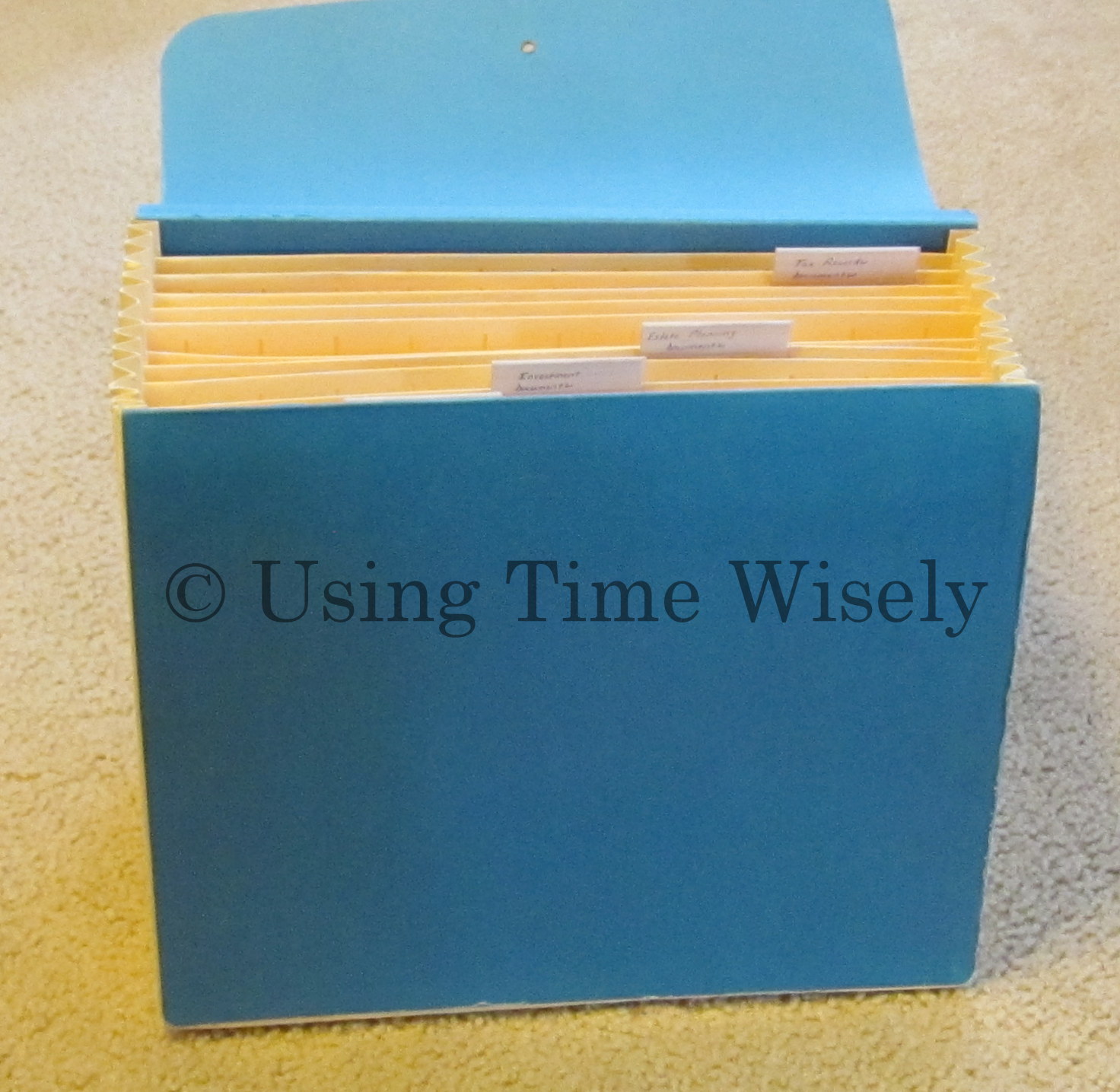
With federal, state, and electronic filing paperwork, I keep the following documents within the 11th file opening of File Box 3:

Federal Tax Documents

    • Copy of tax refund check
    • Federal Income Tax Return with Schedules

State Tax Documents

    • Copy of tax refund check
    • State Income Tax Return

Electronic Filing Documents

    • TaxAct Declaration
    • TaxAct Filing Instructions for Federal and State
    • TaxAct Status Report
    • TaxAct Confirmations
    • TaxAct Joint Return vs. Separate Returns Analysis

Each of these sections is either stapled or paper clipped together and then one large paper clip combines all three sections into one bundle. This bundle is housed behind our summary sheet and is the first of three years kept within this file opening of our tax records category.

In using time wisely, I keep the main tax documents within this file opening while the specific documents are housed with our last 3 years of documents in a large tote. As I file our taxes each year, I like to compare our returns to see the changes to our deductions based on the new tax laws.

The next set of documents in this file opening is our 2011 Tax documents which I will share next week. Keep on working on those important documents as you will not regret your investment of time. Happy organizing!

Question: Do you elect to have your refund automatically deposited into your bank account? 

Filed Under: Box 3, Tax Records, Document Organization Tagged With: taxes

Tax Records: 2011 Tax Documents

September 8, 2013 by Tracy

Tax RecordsDocument organization takes time and energy. Having recently purged our tax boxes, I ended up with two 20-gallon totes full of paperwork to shred. Now, I had let our tax documents pile up, so I still had records from 2007. (I said it had been awhile. :-)) It was so nice to rid our home of all that outdated paperwork.

In choosing what to keep and what to toss, I made my decisions based on what I needed. The Internal Revenue Service (IRS) typically has 3 years to audit a tax return and 10 years to collect taxes. Since our taxes have been paid each year, I keep 3 years worth of records.

These records are all the statements, payments, contribution records, donation receipts, interest notices, tax forms, and other documents needed to file our taxes for that year. Should the IRS choose to audit our tax returns, I will have all the records available to prove the amounts entered for each line item.

In addition to 3 years of records, I also keep every tax return we file with the W-2 forms. My reasoning is to prove our Social Security benefits should the Social Security Administration change the laws or lose our information.

Keeping the hard copies of the records is for my peace of mind. These small packets do not take up much space, and I cannot recreate these documents should I need them in the future.

Now, I house all those records in 20-gallon totes. In our important documents file, I keep the current 3 years of tax returns. The last post was focused on our 2012 tax documents. Today, I will share the records kept for our 2011 tax documents.

2011 Tax Documents

Located in the 11th file opening of File Box 3, the first bundle of paperwork is our 2012 tax documents. The second bundle consists of these 2011 tax documents:

Federal Tax Documents

    • Copy of tax refund check
    • Federal Income Tax Return with Schedules and Worksheet

State Tax Documents

    • Copy of tax refund check
    • State Income Tax Return

Electronic Filing Documents

    • TaxAct Declaration
    • TaxAct Filing Instructions for Federal and State
    • TaxAct Status Report
    • TaxAct Confirmations
    • TaxAct locked in price for 2012 at a discounted price

Each of these sections is either stapled or paper clipped together and then one large paper clip combines all three sections into one bundle. This bundle is the second of three years kept within this file opening of our tax records category.

Keeping the records in two places might cause more confusion than order. If so, then do what is best for you. For me, I sometimes need to know what our gross annual income was for a particular year. By having those records in our important document file within easy reach at my desk, I can quickly locate that information. If I had the records in the totes, then I would need to go to storage to get them.

I share my system as an example of what is working for me. Finding a system that saves you time and energy is the key. Keep on organizing those important documents as we tackle those piles of paperwork. Happy organizing!

Question: Do you keep your tax documents in one location or in multiple locations?

Filed Under: Box 3, Tax Records, Document Organization Tagged With: taxes, filing system

Tax Records: 2010 Tax Documents

September 15, 2013 by Tracy

Tax RecordsAs I pull out the last few items within our important documents filing system, I am amazed at how far our family has come. As I see the 2010 tax documents, I am reminded of life at home with little ones.

I had a new nursing baby (Miss 3), spent weeks reading books and singing songs while potty training (Miss 6), and prepared our family for the kindergarten change (Mr. 8). This was also a time where I typically stayed in my pajamas all day as life was just that busy.

Blogging had intrigued me in mid-2010, and I began researching and reading before diving into this journey. So, looking back over these 2010 tax documents brings back good memories and gratitude for the progress made within my family.

In winding down this tax category, the last bundle within the 11th file opening of File Box 3 consists of our 2010 tax documents. When I file our 2013 document, these 2010 documents will move to our totes as I only keep the last 3 years of tax records within our important documents file.

2010 Tax Documents

Comprised of our federal, state, and the setup information and first electronic filing documents, our 2010 tax bundle is housed behind the 2012 and 2011 bundles:

Federal Tax Documents

    • Copy of tax refund check
    • Federal Income Tax Return with Schedules and Worksheet

State Tax Documents

    • Copy of tax refund check
    • State Income Tax Return

Electronic Filing Documents

    • TaxAct User Agreement
    • TaxAct Declaration
    • TaxAct Filing Instructions for Federal and State
    • TaxAct Status Report
    • TaxAct Confirmations

Each of these sections is either stapled or paper clipped together and then one large paper clip combines all three sections into one bundle. This bundle is the third of three years kept within this file opening of our tax records category.

Keeping these records close by came in handy when the IRS in 2012 challenged an entry on our 2010 return. Though our situation was not an audit, I still had to verify our records before handling the situation with the IRS. I will share my experience with handling this situation in the next and last post for the tax record category.

As you continue filing and organizing your important documents, start where you are. You know that pile on the floor behind your desk that you will get to one of these days. Start with that one.

Setup your file and then start adding paperwork. As you find the paperwork a home, you can then start to organize each section. The important step is to start. Happy organizing!

Question: How was your pace of life 3 years ago? 

Filed Under: Box 3, Tax Records, Document Organization Tagged With: filing system, taxes

Tax Records: How to Dispute an IRS Notice – Part 1 of 2

September 22, 2013 by Tracy

Tax Records: How to Dispute an IRS Notice – Part 1 of 2

Photograph Credit: Microsoft Images

When I think of taxes and the IRS, I get a bit nervous. I get a knot in my stomach every year before clicking that submit button when electronic filing our tax returns. So, when we received an IRS notice in March of 2012 indicating a $1500 error, I immediately felt sick.

Thoughts that went through my mind were how could I have missed such a huge amount, payment would need to come from our emergency fund, and why did it take over a year to notice the error.

In retrospect, I should have just relaxed and gone to my documentation. Please learn from my experience by accepting the notice and dealing with it in an organized manner.

The evening I received the notice, I waited until the kids were in bed to concentrate on understanding and working through the information. Dealing with the issue quickly helped put my mind at ease and clear the air well before the deadline. I share how to dispute an IRS notice to calm you should you also receive a notice.

Part 1: Preparing your Case

These are tips that I found helped me – as dealing with the IRS is one of the top items on my I’D RATHER BE DOING ANYTHING OTHER THAN THIS list. 🙂

1. Gather your Tax Documents

Keeping our tax returns in our important documents file, I went to the 11th file opening and retrieved our 2010 federal tax return.

2. Choose a Quiet, Non-interrupted Space

Waiting until my children went to bed gave me a chunk of time at my desk without interruption in which to work.

3. Take a Deep Breath

Giving myself a moment to collect myself, clear my head, and focus on the task at hand, I took a series of deep breaths before looking at the notice.

4. Read the Notice in Full

Our notice was 12 pages in length. Of course, some of it was in legal terms, but I worked my way through the information.

5. Identify the Line Item Issue

For us, the notice issue was when we converted our Traditional IRA to a Roth IRA. We took advantage of the tax code loop hole and chose to defer paying taxes on the total amount until 2011 and 2012. Since Paul and I both converted, the IRS was asking for the total tax from both our accounts in 2010.

6. Prove your Choice

I went back to our tax return to find our nondeductible IRA forms and confirmed that these were filed electronically with our tax return.

7. Organize your Proof

With the documentation collected and realizing that we had filed correctly, I put all the paperwork in the order I needed to contact the IRS.

As I prepared my case, I became more confident realizing that the IRS made a mistake. I relaxed knowing that our family would not need to pay the $1500 amount indicated as half of the tax was claimed on our previously filed 2011 tax return and the other half would be claimed on our 2012 return.

Dealing with the IRS is not a walk in the park but by keeping our documents and confirmations of actions taken, I had proof to prepare my case. The second part of this short series will share how I addressed the notice with the IRS.

If you receive a notice from the IRS, then gather your tax documents, choose a quiet, non-interrupted space, take a deep breath, read the notice in full, identify the line item issue, prove your case, and organize your proof. With your case prepared, you will have a better understanding of your situation when dealing with the IRS. Happy preparing!

Question: Have you ever received an IRS notice?

Filed Under: Box 3, Tax Records, Document Organization Tagged With: taxes, Dispute

« Previous Page
Next Page »

Welcome to Using Time Wisely!


Presenting organizational tips and tricks to save you money, energy, and time. Enjoy the journey of Using Time Wisely.

Looking for something?

Copyright © 2026 · Lifestyle Pro Theme on Genesis Framework · WordPress · Log in